



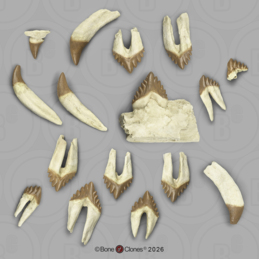
Fossil Whale Teeth, Basilosaurus cetoides
This archaeocete whale from the late Eocene is believed to be around 35 million years old. It is found in the Gulf Coast states of the United States, with a significant presence in Alabama, where it has been designated the official state fossil. Basilosaurus, one of the first fully aquatic whales, had large multi-cusped teeth adapted for shearing fish and squid, with cheek teeth about 2 inches wide and tall. Unlike modern cetaceans, Basilosaurus possessed a variety of teeth, including canines and molars, which suggests it may have been capable of chewing its food. It is believed to have been one of the largest animals of the Paleogene period, reaching around 70 feet in length and weighing up to 15 tons! As a fierce apex predator, Basilosaurus hunted sharks, large fish, and the smaller dolphin-like relative, Dorudon. Whales evolved from terrestrial mammals and are part of the large group of mammals that are even-toed ungulates called Artiodactyla. While modern whales lack external hind limbs, they have vestigial pelvis bones, a last remitment of their ancient terrestrial heritage. We are grateful to the Babiarz Institute of Paleontological Studies for the opportunity to cast these teeth.
$695.00
|
||||
Individual Teeth


Newsletter Signup


9200 Eton Ave.
Chatsworth, CA 91311 USA
© 1992-2026 Bone Clones Holdings. All Rights Reserved.